Most teams didn’t plan to depend on five model providers — it just happened. As of 2026, 37% of enterprises run 5 or more models in production, routing one workload to OpenAI, another to Anthropic, and a third to Google or DeepSeek, because no single model wins everywhere. Wire each up with its own SDK, key, billing, and retry logic, though, and you’ve built a tangle nobody owns. An LLM gateway solves that: a single control plane in front of every provider that normalizes requests so you can route by cost, fail over automatically, enforce security, and see every call from one place — exactly what a gateway like OrcaRouter is built to do.
Quick take: An LLM gateway is one OpenAI-compatible endpoint in front of many models. You change a base URL instead of integrating each provider, then get cost routing, automatic failover, governance, and observability once — centrally — instead of re-implementing them per app and per model.
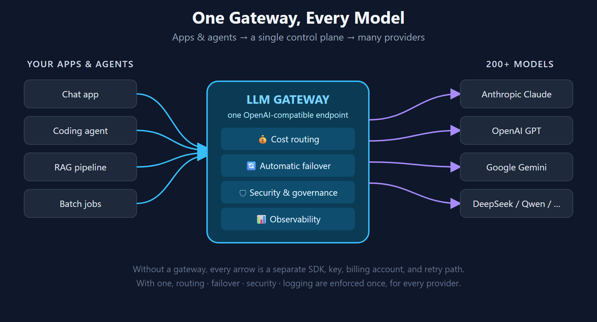
One endpoint in, many providers out. The gateway is where routing, failover, security, and logging live.
Direct API calls vs. one gateway
The difference isn’t subtle once you’re past a single model.
| Direct API calls (per provider) | One LLM gateway | |
| Integration | A separate SDK, key, and request format per provider | One OpenAI-compatible endpoint; switch models by changing a parameter |
| Failover | Build retry/fallback logic in every app | Automatic provider fallback on errors like 429/500/503 |
| Cost control | Reconcile multiple invoices; no shared view | Per-request cost tracking and routing by price-performance |
| Security | Re-implement redaction and access control per integration | Enforced once at the boundary for every call |
| Observability | Stitch together separate logs | One dashboard for cost, model, latency, and tokens |
A team “using GPT for summarization and Claude for code generation would otherwise need to manage two SDKs, two authentication setups, and two billing systems,” as Braintrust puts it — and that’s just two providers. The gateway collapses that into one integration.
See also: Year 2026 and Health Challenges
What an LLM gateway actually does
A good gateway is a thin, fast reverse proxy built for model traffic. Four capabilities matter most.
1. Cost routing
Models have wildly different price-performance profiles, so the gateway picks the cheapest one that can do the job and tracks spend per request. Vendors report meaningful savings from adaptive routing — OrcaRouter, for example, claims up to ~40% cost reduction with zero token markup (you pay provider prices). Routing becomes a config setting, not a code change in every app.
2. Failover and reliability
Even at 99.99% uptime, that’s still 52 minutes of downtime a year per provider — and rate limits cap throughput long before that. A gateway detects errors and rate-limit responses and reroutes to a backup model with no application-side code, so one provider hiccup doesn’t take your product down. The overhead can be tiny: well-built gateways add single-digit-millisecond latency at production load.
3. Security and governance
Every direct call potentially ships data to a provider you don’t control. A gateway is the natural place to enforce PII redaction, content guardrails, role-based access (RBAC), and budget limits before a request is billed or leaves your perimeter — the same model-agnostic control plane that AI agent security best practice now demands. Do it once and every model inherits it.
4. Observability
You can’t optimize or audit what you can’t see. The gateway logs every request — model, cost, latency, tokens — to a single dashboard, and the better ones add prompt versioning, A/B testing, and rollback. That replaces a pile of custom logging pipelines with one source of truth
The four pillars of an LLM gateway. Each is enforced once, centrally, across every provider. Source: OrcaRouter (vendor-reported); Braintrust.
When do you actually need one?
You don’t need a gateway for a weekend project on one model. You very likely do once any of these is true:
- You use more than one provider — or expect to. Avoiding lock-in is the most-cited reason enterprises deploy across competing platforms (69% use Google models, 55% OpenAI, often simultaneously).
- You’re in production and reliability matters. Outages and rate limits are routine; failover shouldn’t be bespoke per app.
- You handle sensitive data or run agents. Centralized redaction, guardrails, and access control are far easier to enforce at one boundary.
- You can’t see your spend or behavior. If nobody can answer “what did we send to which model, and what did it cost?”, you need centralized observability.
This is now a market in its own right: the LLM middleware-gateway segment is projected to grow from USD 18.9M in 2026 to USD 189M by 2034 (a 49.6% CAGR), with roughly 42% of enterprises already running a middleware layer for AI infrastructure.
The bottom line
An LLM gateway turns “many providers, many integrations, no control” into “one endpoint, one control plane” — where cost routing, failover, security, and observability stop being per-app afterthoughts and become defaults you get everywhere. With over 80% of enterprises expected to ship GenAI in 2026 and most already running multiple models, the question isn’t whether you’ll have a gateway — it’s whether you’ll build a fragile one by accident or adopt a real one on purpose.
Frequently asked questions
What is an LLM gateway? It’s an infrastructure layer — a reverse proxy — that routes requests from your apps to many model providers through a single endpoint, adding routing, failover, cost control, security, and observability without changing application code.
How is it different from calling APIs directly? Direct calls mean a separate SDK, key, and billing per provider, with retry and security logic re-built in each app. A gateway gives you one OpenAI-compatible interface and enforces everything once, centrally.
Does a gateway add latency? A well-engineered gateway adds very little — top implementations report single-digit-millisecond overhead even at high request rates.
Can an LLM gateway cut costs? Yes — by routing each request to the cheapest capable model and tracking spend centrally. Vendors report up to ~40% savings from adaptive routing.
Do I need a gateway for a single model? Usually not. The value appears once you have multiple providers, reliability needs, sensitive data, or no central view of cost.